For most of its history, geothermal energy carried a frustrating asterisk. The idea is beautiful in its simplicity: the rock beneath our feet is hot, that heat is limitless on any human timescale, and it flows around the clock regardless of weather or time of day. Yet for decades geothermal remained a bit player in the energy mix, confined to a handful of geologically blessed places like Iceland, where volcanic activity brings hot water and steam close enough to the surface to tap. Everywhere else, the heat was simply too deep, too dry, or too locked inside solid rock to reach economically. That limitation is now falling away, and the reason it is falling away is one of the more unexpected stories in modern energy.
The breakthrough did not come from within the geothermal industry at all. It came from oil and gas. Over the past two decades the fossil fuel sector perfected a suite of techniques, horizontal drilling, hydraulic fracturing, and fiber-optic sensing among them, in order to extract oil and gas from tight rock that was once considered unreachable. A new generation of engineers realized that these same tools could be pointed at a completely different target. Instead of drilling for hydrocarbons, they could drill for heat. This is the core idea behind Enhanced Geothermal Systems, or EGS, and it changes the entire geography of what is possible.
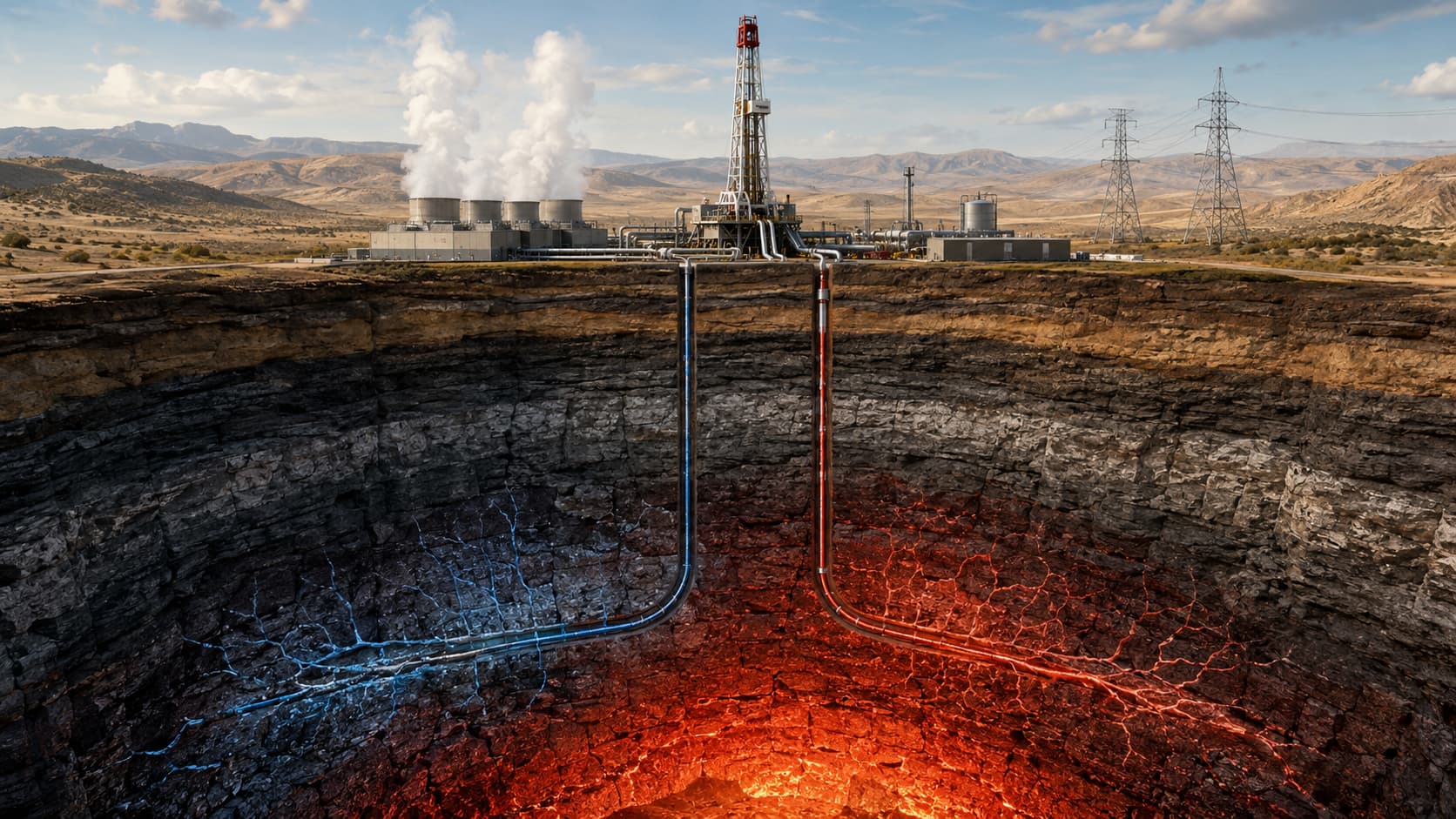
Traditional geothermal depends on finding a natural underground reservoir of hot water or brine, a rare and specific geological accident. EGS does not wait for nature to provide one. Instead it creates the reservoir artificially. Engineers drill down into hot dry rock far below the surface, then fracture it to open up pathways, and pump water into the cracks. The water absorbs the heat of the rock, returns to the surface as steam or hot fluid, and drives a turbine to make electricity. Because hot dry rock exists almost everywhere if you drill deep enough, this approach unshackles geothermal from its volcanic strongholds and makes it, in principle, deployable across enormous swaths of territory that were previously off the map entirely.
For years this remained a promising idea trapped in laboratories and computer models. What makes the present moment genuinely different is that it has crossed into the real world at commercial scale. The company that has done the most to prove it is Fervo Energy, whose commercial pilot in Nevada established itself as the most productive enhanced geothermal system in history by successfully drilling a horizontal well pair, reaching high reservoir temperatures, and demonstrating controlled flow through rigorous testing. That pilot took the technology out of the realm of simulation and onto the grid, and it did so using drilling methods borrowed wholesale from the oil field.
The pace of improvement since then is what has caught the attention of the entire energy world. The single greatest obstacle to geothermal has always been cost, and cost in this business is dominated by drilling. Here the progress has been dramatic. Between its early pilot and its later production wells, the company cut drilling times by roughly seventy percent in just two years, while simultaneously reaching hotter rock than before. That is not incremental tinkering. It is the kind of steep learning curve that transforms an expensive curiosity into a competitive power source, and it mirrors exactly the way shale drilling costs collapsed once the industry found its rhythm.
The scale of what is now under construction reflects that confidence. The company’s flagship development in Utah, sited in a county with a long heritage of oil and gas work, is set to become the largest next-generation geothermal project in the world. It is designed to begin delivering firm, around-the-clock clean power to the grid and to expand toward several hundred megawatts as more wells come online, with the output already contracted to major utilities under long-term purchase agreements. That last detail matters enormously. It means real buyers are betting real money that this power will be delivered, which is the truest signal that a technology has arrived. Appraisal drilling at new sites has meanwhile confirmed rock temperatures well above the threshold for commercial viability, drilled in a matter of days rather than weeks.
The word that keeps recurring in all of this is firm, and it is the quiet key to why geothermal matters so much right now. Wind and solar are cheap and clean, but they are intermittent, rising and falling with the weather and the sun. A fully decarbonized grid needs a source that runs constantly to fill the gaps, and until recently the options for that role were limited and mostly polluting. Geothermal offers exactly this: carbon-free power available every hour of every day, a natural complement to wind and solar rather than a competitor. Analysts modeling the future grid increasingly see it as a critical missing piece, with estimates suggesting advanced geothermal could eventually supply a substantial share of national electricity demand.
None of this means the challenges have vanished. Deeper, hotter wells demand drilling and completion equipment rated for punishing conditions, and every component must be pushed to withstand higher temperatures. Fracturing rock underground carries a risk of induced seismicity that must be carefully managed with established protocols. And while costs are falling fast, the technology still has to prove it can hold that downward trajectory across many projects in many different geologies. These are real hurdles, but they are engineering problems on a known curve, not fundamental barriers of physics.
What makes this an inflection point rather than just another hopeful headline is the rare alignment of forces behind it. The technology is ready, the market demand for firm clean power is surging, and the political support is broad enough to cross the usual divides. After a century as a niche resource, the heat beneath our feet is finally becoming something we can reach almost anywhere. The Earth was always going to be warm. We are only now learning how to drill for it.